Skip to content
HPEC
  • Home
  • About HPEC
    • Meeting Minutes
  • News
  • Resources
    • HP Environmental Resource Inventory (2012)
    • HP Natural Resource Inventory (1992)
    • Highland Park Native Plant Reserve
    • Native Plants in HP Gardens
    • Birds of Middlesex County
    • Additional Resources
    • Other Environmental Links
      • Sustainable Highland Park
      • Lower Raritan Watershed Partnership
      • Rutgers NJAES
      • Friends of the East Brunswick Environmental Commission
      • Nature Notes
  • Bird Sightings
    • 2022
    • 2021
    • 2020
    • 2019
    • 2018
    • 2017
    • 2016
    • 2015
    • 2014
    • 2013
    • 2012
    • 2011
    • 2010
    • 2009
    • 2008
    • 2007
    • 2006
    • 2005
    • 2004
    • 2003
    • 2002
  • Reserve Park Space
  • Plants
  • Contact Us

News

News

Remediation at American Properties, Cleveland Avenue, is Complete
The remediation of American Properties, Cleveland Avenue (Midland-Ross, old Illuminating Experience site) by Honeywell has been completed. The site will
Remediation Continues at Midland=Ross/American Home Properties Highland Park LLC Site
Remediation continues at 100 Cleveland Avenue (the former Midland-Ross Corporation and Illuminating Experience sites). The site is being remediated by
On The Meadows Trail
The leaves on the trees are starting to show their colors and the last of this season’s White Snakeroot is
Remediation Continues at Midland=Ross/American Home Properties Highland Park LLC Site
Remediation continues at 100 Cleveland Avenue (the former Midland-Ross Corporation and Illuminating Experience sites). The site is being remediated by
Air Monitoring Testing During Remediation at Midland Ross/American Properties Highland Park LLC Site
Introduction As many residents are aware, American Properties Highland Park has been approved to build 110 townhouses at 233 Cleveland
Bat Houses Installed at the Environmental Education Center
Highland Park Boy Scout, Jacob Kleinmann, installed 4 bat houses at the Environmental Education Center site, as part of his
Environmental Center Construction
With the glass walls fitted into the building's frame, the Eugene Young Environmental Education Center on River Road in Highland
Centennial Park Construction
The hard structures of Highland Park's new Centennial Park at Raritan Avenue and River Road are beginning to appear against
Centennial Park Construction - 2
Construction equipment rests high in the air atop materials it has scooped out at the future site of the Centennial
Centennial Park Construction
Construction began in July 2006 for Centennial Park in the triangular lot formed by the intersection of River Road, Raritan
« Previous 1 2 3 4 Next »

Remediation at American Properties, Cleveland Avenue, is Complete

The remediation of American Properties, Cleveland Avenue (Midland-Ross, old Illuminating Experience site) by Honeywell has been completed. The site will be the future home of Heritage at Highland Park. 

The following three reports, which are available for review in the Borough Clerk’s Office, document the cleanup/remediation:

  1. Remedial Investigation Report/Remedial Action Work Plan for Soils –Full Report.
  2. Remedial Investigation Report for Groundwater = Full Report
  3. Preliminary Assessment/Site Investigation Report for Groundwater Area of Concern MR=9 – Full Report

American Properties, LLC is now grading the site prior to initiating construction of the condominium complex.

ANW

Remediation Continues at Midland=Ross/American Home Properties Highland Park LLC Site

Remediation continues at 100 Cleveland Avenue (the former Midland-Ross Corporation and Illuminating Experience sites). The site is being remediated by Honeywell Corporation, which assumed responsibility when Midland-Ross was acquired many years ago. This is the final phase of the cleanup of this industrial site, which was contaminated by past industries.  The site is concurrently being redeveloped by American Home Properties Highland Park LLC as a residential condo community.

During the remediation, particle detectors monitor dust levels and air samples are taken to monitor for potential chemical contamination. There are 5 air-monitoring stations on the site, which is diagrammed in the attached reports.   There are trigger levels for dust levels  (8o μg/cubic meter), which will require investigation and actions levels (109 μg/cubic meter) where work is stopped.Ten reports for the following dates are provided:

Air Monitoring Report 081018
Air Monitoring Report 081718
Air Monitoring Report 082418
Air Monitoring Report 083118
Air Monitoring Report 090718
Air Monitoring Report 092118
Air Monitoring Report 091418
Air Monitoring Report 092818 Rev1
Air Monitoring Report 092118
Air Monitoring Report 100518 Rev1

There were a few anomalies in the dust levels due to wind or activities close to air monitoring stations such as wood chipping or unloading clean fill. One anomaly was the failure of the network collecting data with reading going to zero. These anomalies have duration of last seconds. On occasion, air chemical contamination was detected just above the detection levels but far below levels of concern. These contaminates were the expected compounds from this site,

Questions – contact the Environmental Commission via the Contact Menu.

On The Meadows Trail

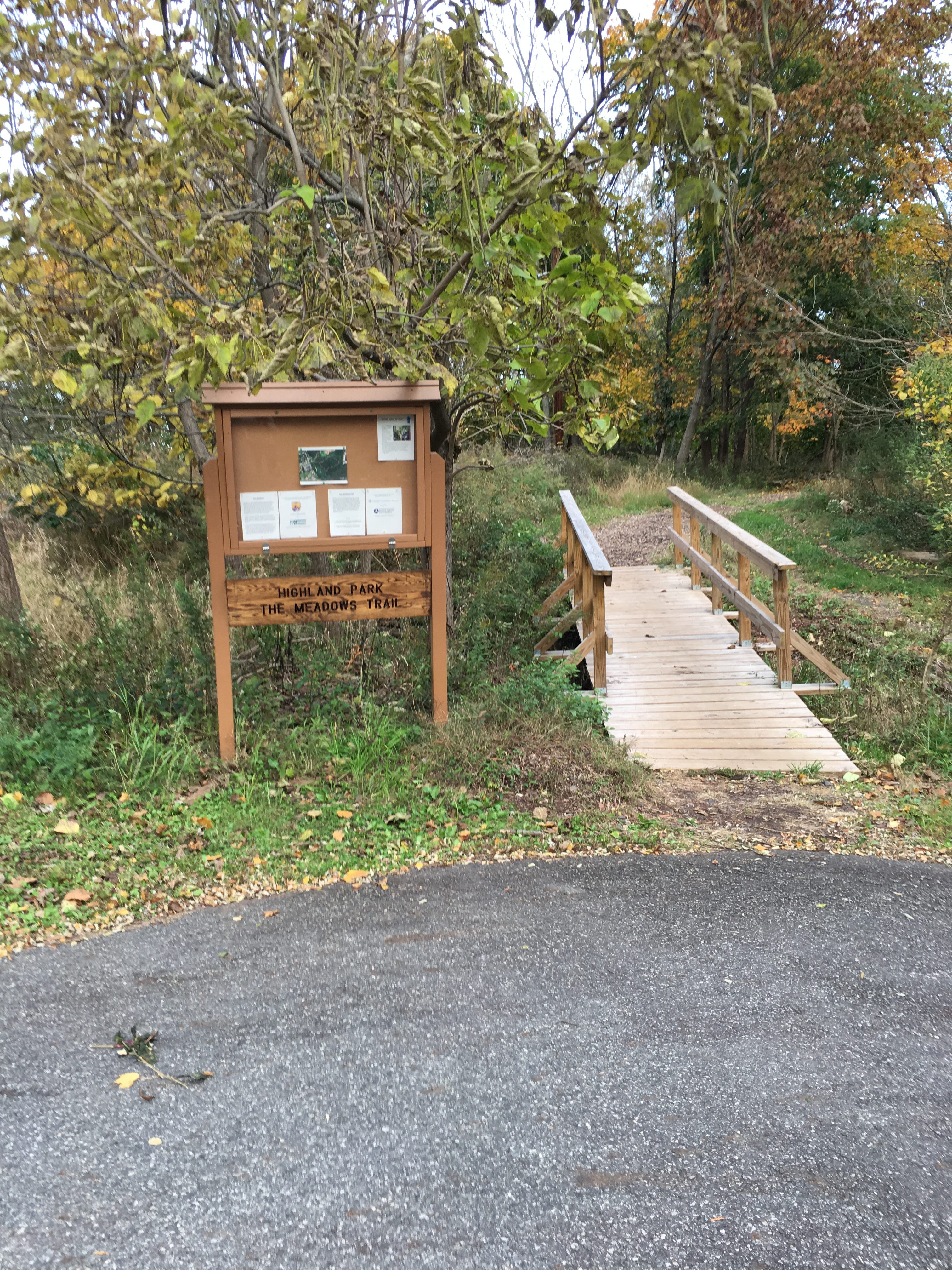
New Entrance to Meadows Trail (Fall 2018)

The leaves on the trees are starting to show their colors and the last of this season’s White Snakeroot is still in blossom along the trail, which means our work season for this year will be over fairly soon.

And since it’s been a while since the last update, so we thought this was good time to let everyone know what’s been happening out “On the Meadows Trail”.

The weather played a big part in our regular management of the trail this year. There were too many weekends when it would rain and we weren’t able to do our regular mowing and trimming to make sure it was enjoy able and safe for everyone.  We expect to be able to mow the grassy sections of the trail at least once more before winter as we do the annual cutting of non-native invasive plants in the trailside areas.

We have a bit more work to do on the new trail entrance that we built last year and we’re nearly done with construction of the new observation platform. The new entrance will get some non-skid material applied to its surface – a weather dependent task – and the path to the observation platform needs some work.  Both these projects were funded throughhe National Recreational Trails grant that was awarded to the Boro in 2016.

Once our work for this year completed we’ll be looking ahead to getting underway again in the Spring.  Next year will be another busy one. There’ll be a major effort to manage the non-native invasive plant populations in the Meadows; we’ll be putting in an order for some new trees and other native plants for planting in April; and a new section of trail will be built leading from the main trail to the upper part of the Bike Path. We wanted to work on this new trail section during 2018 but have had to wait until PSE&G stakes out the outline of the solar farm that will be built on the upper portion of the Meadows. We’ll have more to report on this as the project progresses.

We hope everyone who’s used the trail has enjoyed the experience.  If you have any comments, questions or suggestions, or would like to become a member of the Meadows Trail Crew, let us know. We’re out working on the trail every Sunday morning (weather permitting), or you can get in touch with us through the Environmental Commission web site.

Steve Barnes

Environmental Commission

Remediation Continues at Midland=Ross/American Home Properties Highland Park LLC Site

Remediation continues at 100 Cleveland Avenue (the former Midland-Ross Corporation and Illuminating Experience sites). The site is being remediated by Honeywell Corporation, which assumed responsibility when Midland-Ross was acquired many years ago. This is the final phase of the cleanup of  this industrial site , which was contaminated by past industries.  The site is concurrently being redeveloped  by American Home Properties Highland Park LLC as a residential condo community.

During the remediation, particle detectors monitor dust levels and air samples are taken to monitor for potential chemical contamination. There are 5 air-monitoring stations on the site, which is diagrammed in the attached reports.   There are trigger levels for dust levels  (8o μg/cubic meter) which will require investigation and actions levels )109 μg/cubic meter) where work is stopped.

Five reports for the following dates are provided:

Air Monitoring Report 060818

Air Monitoring Report 061518

Air Monitoring Report 062218

Air Monitoring Report 062918

Air Monitoring Report 070618

There were a few anomalies in the dust levels due to wind or activities close to air monitoring stations such as wood chipping or  unloading clean fill. On occasion, air chemical contamination was detected just above the detection levels but far below level of  concern. These contaminates were the expected compounds from this site.

Questions contact the Environmental Commission via the Contact Menu.


Air Monitoring Testing During Remediation at Midland Ross/American Properties Highland Park LLC Site

Introduction

As many residents are aware, American Properties Highland Park has been approved to build 110 townhouses at 233 Cleveland Avenue. This site was the location of industries (including Midland Ross and Illuminating Experience) going back to the early 1900’s. The site has been previously contaminated. Honeywell has the responsibility for remediating the site, has been actively remediating it, and has begun the final phase of the remediation.
There is a large cement foundation still on the site (see Baseline Perimeter Air Monitoring- Part 1, Page 3) . There are joints between slabs of concrete, which contain asbestos in the joints. The sections of concrete with asbestos will be cut out and removed from the site and disposed of at an approved site. The rest of concrete will be broken up, and stock piled for later use in grading the site. Underneath one section of the concrete foundation, there is a contaminated area, which will be remediated by Honeywell prior to construction of the townhouses.
Testing for Dust and Contaminates

 To assure the public health, Honeywell has positioned five (5) air monitoring stations on the site such that whatever the wind direction, the monitors will detect any excess level of dust. Honeywell has performed baseline testing for dust levels, asbestos, and a number of potential chemical contaminates on 5 days in November and December 2016. Future test results, when remediation is occurring, will be compared against this baseline data.

For dust levels, there is a trigger level of 80-µg/cubic meter of air, which will trigger an investigation of the cause; at a level of 109-µg/cubic meter of air (the action limit), work will be stopped, and an investigation will occur. Typically, the corrective action is to wet the work area down with water.

Air samples are evaluated for asbestos fibers by phase microscopy and transmission electron microscopy (TEM) using EPA approved procedures at licensed analytical laboratories.

Air samples were also evaluated for metals and a variety of organic chemicals.

Results

Dust Levels – The levels of dust samples (n=25) were all well below the trigger level (80 µg/cubic meter of air) except one (Air Monitoring Station 5, 11/21/16) which exceeded the action level. It was determined that the dust level excursion was due to a vehicle’s exhaust near the Air Monitoring Station. Results dropped well below the trigger level when the vehicle was moved.

Asbestos – No asbestos was detected in 25 samples.

Chemical Contaminates – No contaminates exceeding NJDEP requirements were detected. For contaminates without NJDEP requirements, several were detected at just above or at the detection level of the analytical methods, which are far below levels of public health concern.

The complete testing report provided by the Honeywell’s contractor “Amec Wheeler Foster” is provided. Due to size restriction of this website on attachments, it is in three parts.Baseline Perimeter Air Monitoring Report-Part 1 ,Baseline Perimeter Air Monitoring Report-Part 2 , Baseline Perimeter Air Monitoring Report-Part 3 .

Next Steps

Future  data summaries and test results will be posted on this website as the remediation of the American Property Highland Park LLC site proceeds.

Bat Houses Installed at the Environmental Education Center

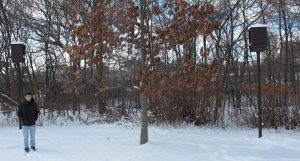
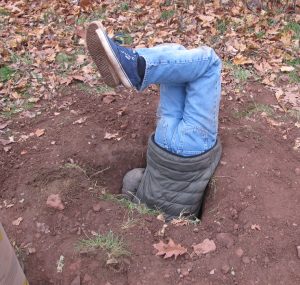
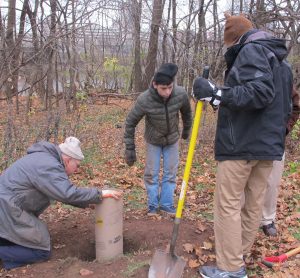
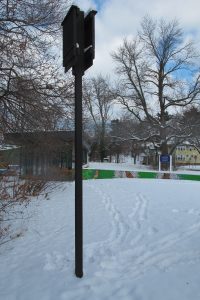
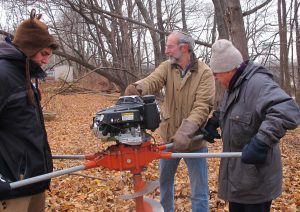
Highland Park Boy Scout, Jacob Kleinmann, installed 4 bat houses at the Environmental Education Center site, as part of his Eagle Scout project. The bat houses were installed on 16 foot cedar posts, with 2 sets of houses on each post, back to back. The bat houses are expected to provide a home for bats which live near the Center and the Raritan River. Bats provide very important environmental value in eating many types of insects.

Environmental Center Construction

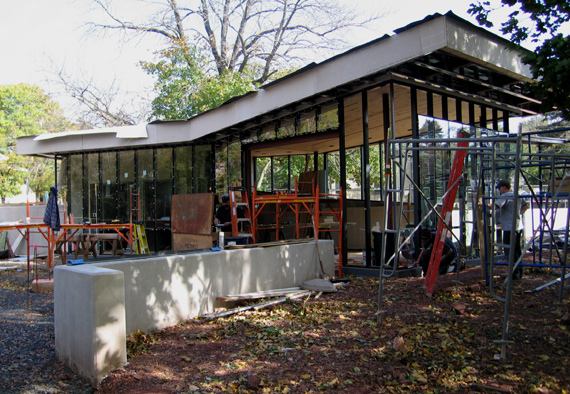
With the glass walls fitted into the building’s frame, the Eugene Young Environmental Education Center on River Road in Highland Park NJ becomes a fully closed building, but also begins to reflect surrounding nature.
Photo: Arnold Clayton Henderson 1/2/2007

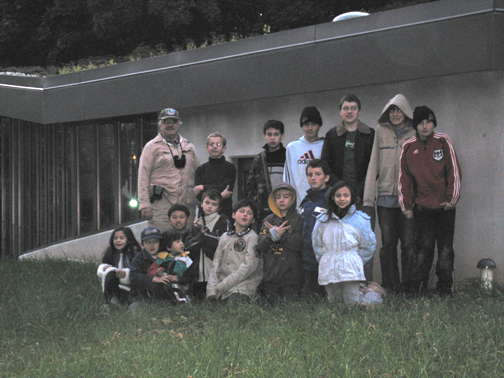
Children show a range of ages in the Highland Park Homeschoolers group, here ready to go inside for their evening program. Note the “green roof” above them. The adult on the left is the HP Environmental Commission’s vice chair, Arnold Henderson, who heads the Environmental Education Centers Working Group. 2007_11_08

Children show a range of ages in the Highland Park Homeschoolers group, here ready to go inside for their evening program. Note the “green roof” above them. The adult on the left is the HP Environmental Commission’s vice chair, Arnold Henderson, who heads the Environmental Education Centers Working Group. 2007_11_08


In November 2007, Highland Park’s Eugene Young Environmental Education Center was ready to host programs by youth groups. 2007. 2007_11_08

In November 2007, Highland Park’s Eugene Young Environmental Education Center was ready to host programs by youth groups. 2007_11_08


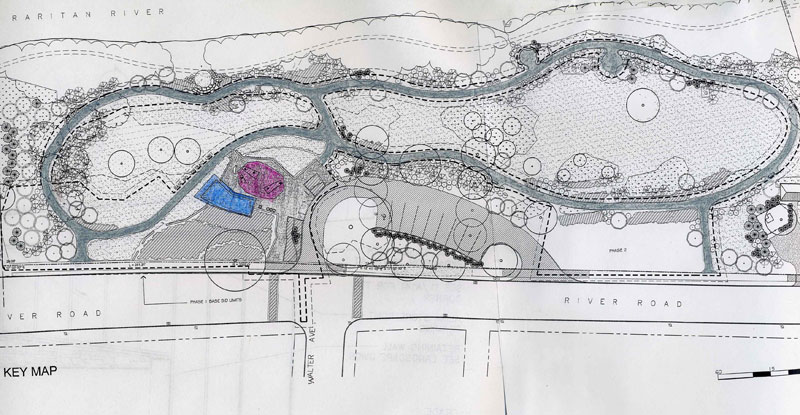
The planned Eugene Young Environmental Center building itself is shown here in blue, set in from River Road opposite Walter Street. The adjacent shade structure (with outdoor seats and a solar demonstration) is in magenta. A path around the site is shown in gray. This is a first stage of bid documents drawn by MKW + Associates, landscape architects. 1/2005


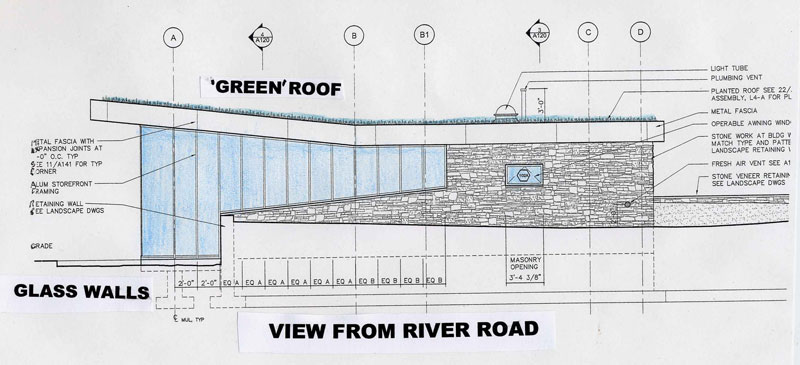
Seen from River Road, the Eugene Young Environmental Center will be set back from the street and rise up from an earth berm covered in plants. The roof, too, will be covered in plants to demonstrate the ‘green roof’ concept. Glass walls for most of the building will allow visitors to see into exhibits there, even when the building is closed. A smaller stone-walled portion gives privacy for the restroom. The building is designed to provide universal/handicap access and passive-solar energy efficiency. It was designed by Sage/Coombe Architects, working with MKW + Associates, landscape architects. 1/2005


NPR Sketch

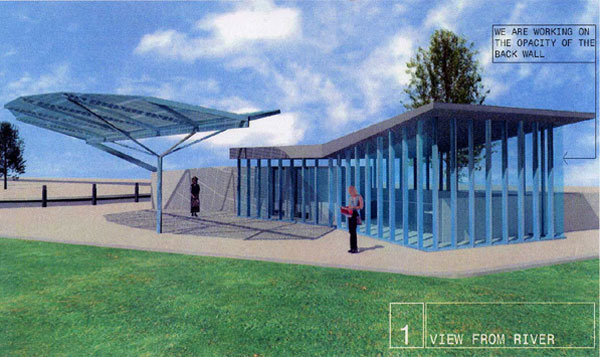
This concept sketch for the proposed environmental education structures at the Native Plant Reserve on River Road is not a finished design, but suggests what could be built if the cost estimates work out. This view from the river side shows 1) the parasol-like shade structure, with its roof of active solar panels, and 2) a glass-walled passive solar building that can house displays or small gatherings. The far side (street side) of the building would have less exposed glass than shown here and instead rise up out of a planted berm and display wall. Public comments are sought (click on Contact Us! at the bottom of this web page). 12/03

Native Plant Reserve

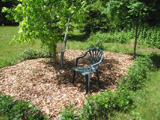
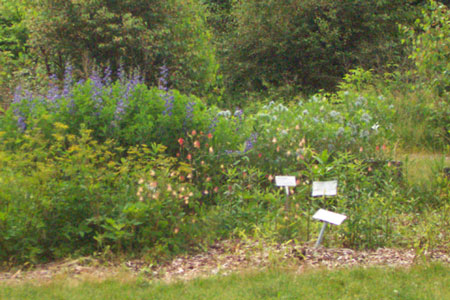
The Native Plant Reserve on River Road at Harrison shows off an ever-increasing collection of native flowers, shrubs, vines, and trees–most of them suitable for your own yard. Signs tell the story of each. It exemplifies today’s search for fitting viable natural spaces into urban settings and won a 2000 Environmental Quality Award from US EPA (Region II).


Photo: Leora Wenger
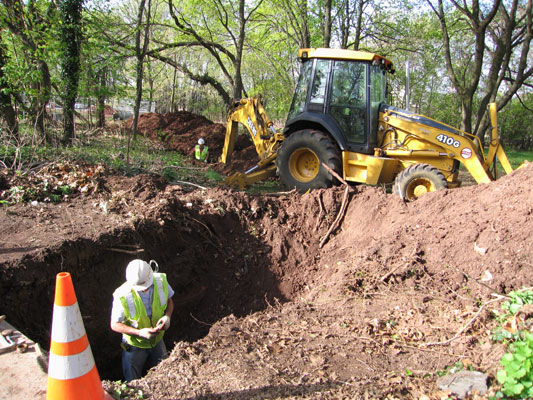
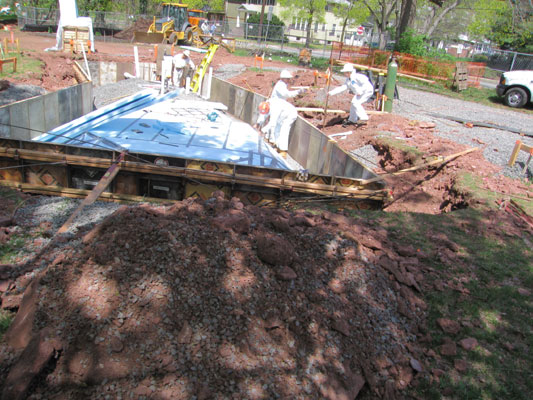
On 30 March 2006, three years after a formal ceremony suggestive of a “groundbreaking” (22 April 2003), ground actually was broken for the Eugene Young Environmental Center at the Native Plant Reserve, River Road, Highland Park (NJ). In this photo, a bulldozer operator cuts carefully into the staked outline for the building, while a worker in white coveralls and protective filter mask holds a measuring rod to control depth. Photo Arnold Henderson 3/30/2006.

With excavation completed for the environmental center’s foundation, frames are being set up for pouring the concrete.
Photo Arnold Henderson 4/6/2006.

Workers ready the trench for connecting the water line to the Eugene Young Environmental Center.
Photo: Arnold Henderson 4/17/2006


Safety Inspector Jennifer gives the workers a hand by passing tools down to them in the excavation for the Environmental Center.
Photo: Arnold Henderson 4/17/2006


Now that concrete has been laid for the foundation and floor of the Environmental Center, weights are placed for load testing.
Photo: Arnold Henderson 4/2006


As forms rise for the walls, the shape of the final building just begins to become visualizable. The large main room is on the right, taking up nearly the whole length of the foundation slab, while a much smaller compartment on the far left begins to show the outline of the rest room and storage area. Photo: Arnold Henderson 5/9/2006


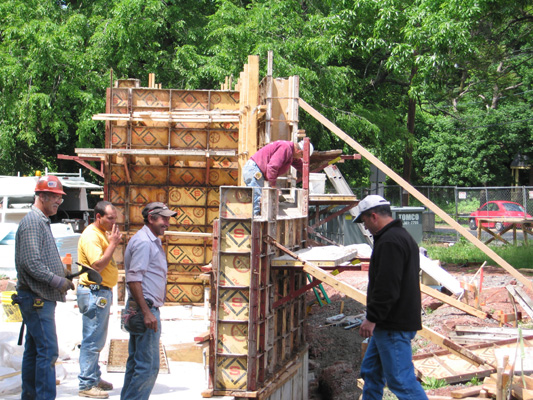
On May 23, the big step at the environmental center was pouring concrete into the wall forms. This is the first piece of the actual building to rise up much above ground level: up to now, the only thing reaching up more than a few inches was the temporary plywood form. In the photo, the worker in the red sweatshirt is reaching in between the two “walls” of plywood to smooth the surface of the concrete just poured into the gap. Not much of this concrete will finally show in the finished building, since a berm of plant-covered earth will be raised up against it, making the building partly earth sheltered. Photo: Arnold Henderson 5/23/2006


With the frames removed, the newly hardened concrete walls for the Eugene Young Environmental Center are now up and in full view. Visualize: glass walls will eventually rise up all around the edge of the concrete slab that you see thrusting out toward you in the foreground. The concrete walls will, in fact, partly disappear under a berm of soil and plants, giving the effect of a mainly glass building rising up out of the ground.
Photo: Arnold Henderson 5/30/06


On June 15, 2006, the environmental center suddenly began to look a lot bigger as forms began to rise for the retaining walls that will reach wing-like out from the building, bracing earthen berms and raised display beds for native plants.
Photo: Arnold Henderson 6/15/06


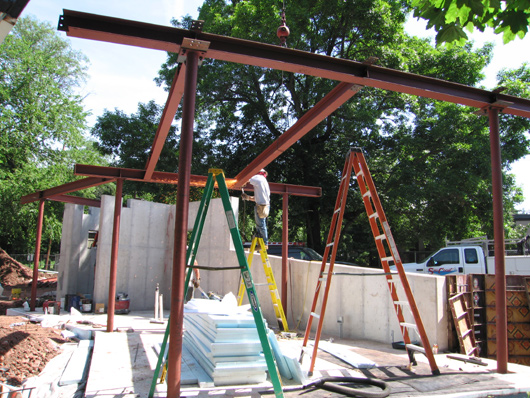
In just a single day, June 16, 2006, the steel frame for the roof canopy of the environmental center building was assembled. A tall crane lowered I-beams to workers who fitted them into place. In this photo, sparks fly (look along the beam just behind the top of the green ladder) as a workman cuts into one of the steel beams to prepare the connecting joint.
Photo: Arnold Henderson 6/16/2006


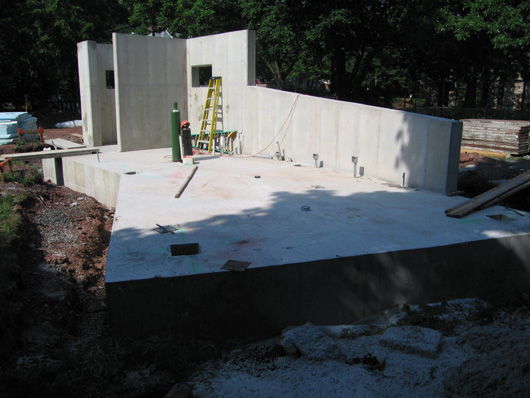
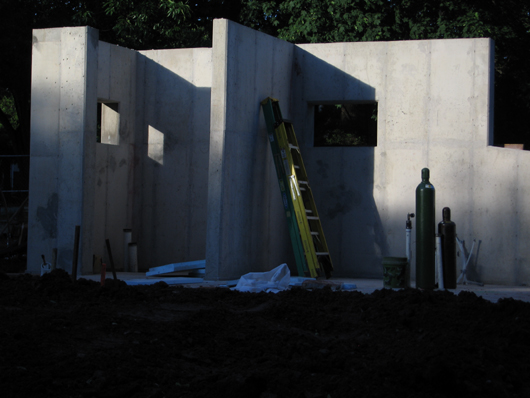
Viewed from the river side with shadows cast by a descending sun, the concrete portion of the environmental center takes on something of the look of a Mayan stone monument, and the mysterious shadows seem to create an extra window–but it’s all still just the practical end of a modern building, storage room to the left, restroom to the right (though still without all its walls). If you look closely, you’ll see the white pipes sticking up for the drain connections.
Photo: Arnold Henderson 6/11/06


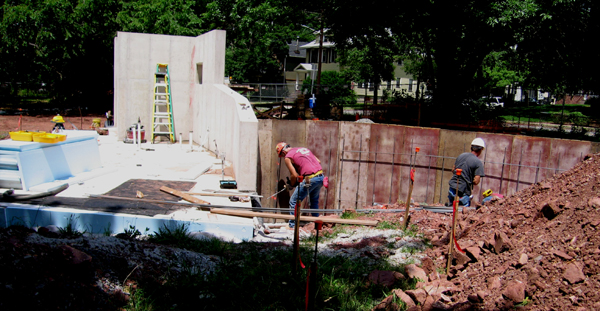
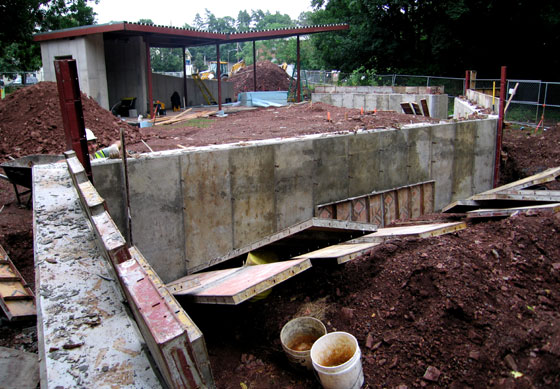
By June 27, the true extent of the environmental center began to be visible. A zig-zag complex of concrete retaining walls was coming into shape and reaching clear to the back of the fenced construction area. These walls, with berms of earth and display gardens resting against them, will finally encircle a broad patio and raised shade structure. We can now see that the center complex will extend back toward the river from the glass-walled building, reaching the edge of the riverside trees.
Photo: Arnold Henderson 6/27/06


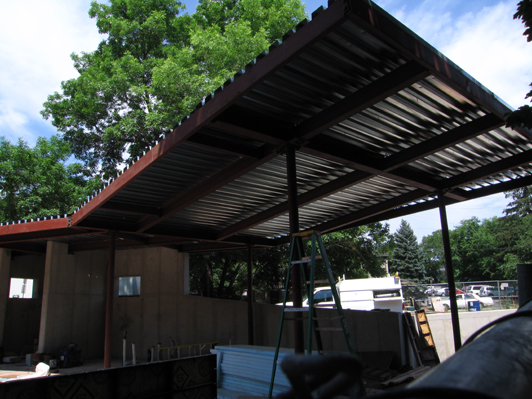
Sheet metal glistens as the roof of the environmental center takes shape.
Photo: Arnold Henderson 6/20/06

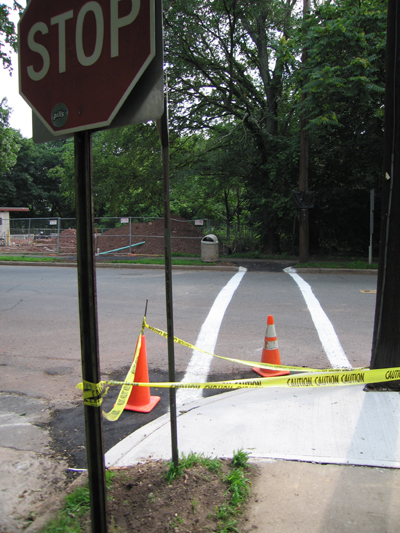
An improved pedestrian crossing of River Road at Walter Street will help users of strollers, wheelchairs, and feet alike to cross directly to the Eugene Young Environmental Center.
Photo: Arnold Henderson 7/2/06


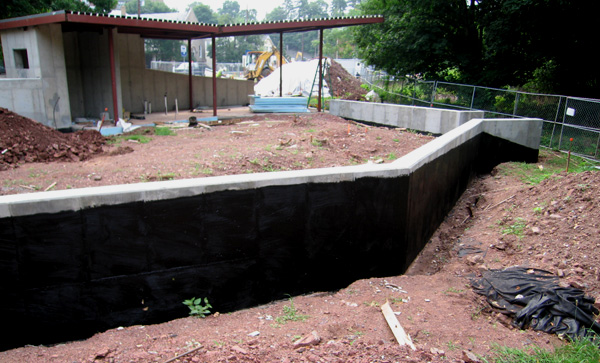
The concrete retaining walls winding across the environmental center site are to support berms of flowers and grasses. Now we can see just how high the earth will finally stand: to the height of the black-tar coating applied on July 20 and 21. Earth and plantings will sometimes envelop the wall, sometimes slope diagonally across it. Within the circle of walls, a shaded patio will be a main gathering point. See view from street.
Photo: Arnold Henderson 7/21/2006


The Eugene Young Environmental Center is designed to function as a giant display case. The glass walls will allow visitors to look in at posters and objects on display, even when the building itself is not open, or is open only for the end that has the rest room, with the main room closed to protect the exhibits. But glass walls have to be held up by something, and that’s what you see installed here at the start of September: the vertical steel slats into which plate glass will be mounted, much as in plate-glass storefronts.
Photo: Arnold Clayton Henderson 9/6/2006


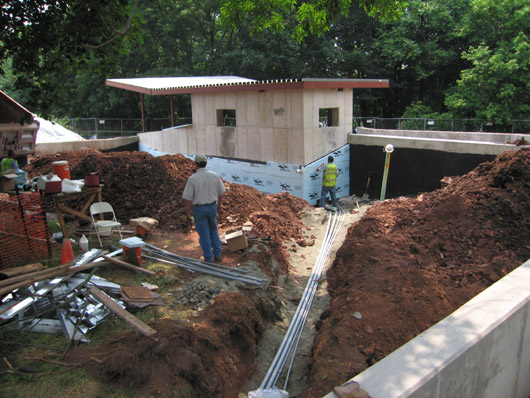
Note the protective black tar and the sheet insulation wrapping the base of the environmental center building. When soil is bermed up against this (later the same day), the building will in part demonstrate the principle of “earth sheltering.” The mass of soil helps even out heat flow. Actually, the covered surface area may not be great enough for a large insulating effect (more area will be of glass in a passive solar design), but something of the principle is there to be seen. Utility connections are visible in a narrow trench, just before being backfilled with earth.
Photo: Arnold Clayton Henderson 7/26/2006


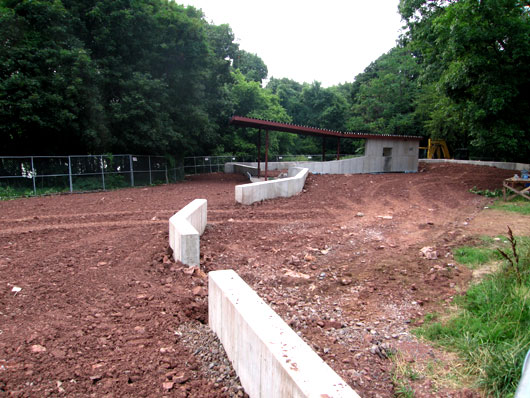
Looking from the street along what will be the south entry path to the Eugene Young Environmental Center, we sense what the entering experience will be. A long, curved walk will pass plantings punctuated by wall segments, with the goal of the building itself in the far distance. Note that soil is now bermed up against its walls. The intended effect is that the building will seem partly hidden in the earth and in plantings, as if growing up out of them.
Photo: Arnold Clayton Henderson 7/26/2006


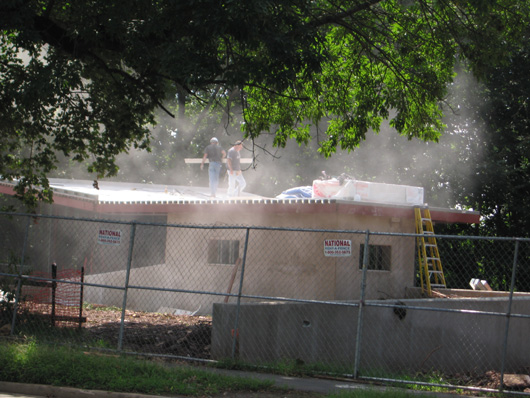
The roof of the Eugene Young Environmental Center will be rather special, a “green roof.” To get plants to grow up there, we have to have a layer of soil. To have a layer of soil and the water it will hold, we have to have an extra heavy layer of waterproofing underneath. That’s what these two men are working on. The cloud of white dust is lingering after some materials were cut.
Photo: Arnold Clayton Henderson 9/7/2006


Just in time for Halloween, workers installed the plate-glass walls of Highland Park’s Eugene Young Environmental Center. Here the glass is about half installed about mid-day of 31 October, 2006. Note how reflections on those panes already installed pick up surrounding trees. In the final effect, the center when viewed from the outside will be a shimmer of reflected nature, while from the inside nature will be visible through the glass in all directions.
Photo: Arnold Clayton Henderson 10/31/2006


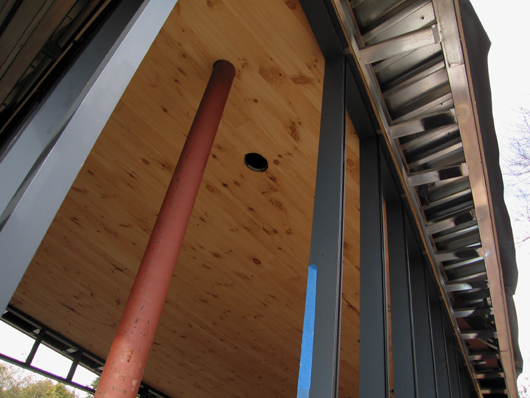
Natural wood is right for the nature-center aspect of the Eugene Young Environmental Center, but if it can also be in some sense “recycled” wood, that’s right for the environmental aspect. Here the wood interior ceiling is being installed on 23 October. The visible grain shows off the natural material, and the source is not new trees cut for lumber but wood salvaged when diseased or damaged street trees in other towns were removed–wood that would otherwise have gone to landfills.
Photo: Arnold Clayton Henderson 10/23/2006


In the upper left, on the flat roof of the Eugene Young Environmental Center, a worker is tossing the first bags of soil to be spread for the “green roof.” A green roof of growing plants (sedums, in this case), makes a building’s roof remain in some degree a “natural” surface. In the lower right, the metal grid sticking out is the folded-up side door. This works like a folding garage door, with glass panels soon to be inserted in the spaces of the grid. Shut, it forms a part of the glass wall. Open, it creates a broad opening in the side of the building. Events can flow from inside the building out through the broad opening of the “garage door” into the space sheltered by the shade structure.
Photo: Arnold Clayton Henderson 11/9/2006.


Parked at the environmental center site, a flatbed truck holds curved white metal pieces. Mysterious they may be as they lie stacked on the truck in the rain, but with imagination you can spread them out and fit them together in your mind to become the bent leaf-shaped roof of the shade structure that will soon be mounted in the center of the patio. They’ll keep the rain off you, then. Photo: Arnold Clayton Henderson 11/8/2006.


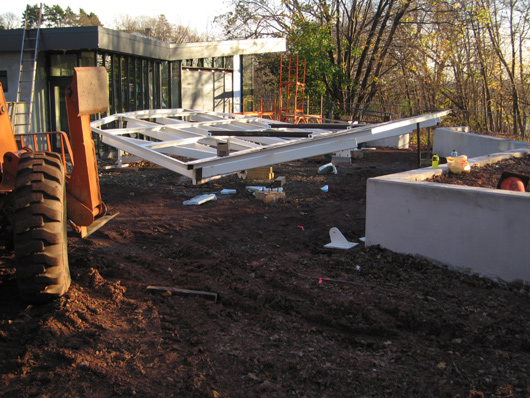
The white framework that will become the roof of the Eugene Young Environmental Center’s shade structure is shown here assembled at ground level. Soon it will be raised up on pillars. At that point the unwalled shade structure will be about as tall and broad as the walled building itself, nearly doubling the roofed area under which people can gather. The effect will be a near doubling of the center’s effective size. Photo: Arnold Clayton Henderson 11/21/2006.


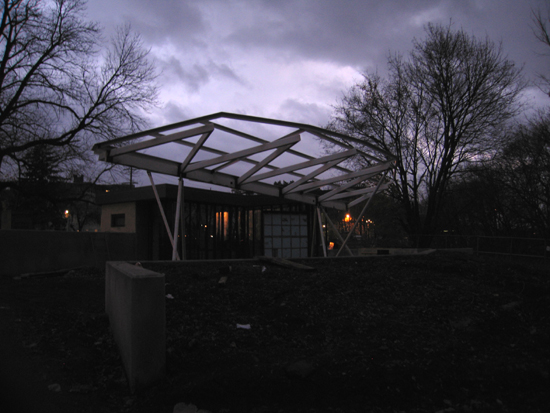
Dusk and a storm coming. The white frame for the shade structure has been raised up; later it received a coat of green paint. By the time the openings in the frame are filled with the final solar panels, it will provide good shelter from that storm or the hot summer sun, doubling the roofed area of the center.
Photo: Arnold Clayton Henderson 12/01/2006.

Centennial Park Construction

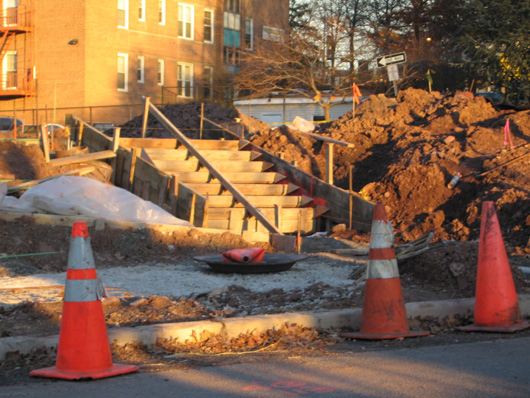
The hard structures of Highland Park’s new Centennial Park at Raritan Avenue and River Road are beginning to appear against the earth-moving that has been the main site activity for many weeks. These wooden forms will be used in creating steps down from the slightly raised parkland to the street below. Partly visible to the left is the beginning of grading for the larger zig-zag ramp that will give universal access at the same point. Other recent work includes constructing concrete retaining walls left of this photo that separate the park from a neighboring house, and the grading out of a hollow for planting a “rain garden” off to the right that will allow storm runoff to be held and partly taken up by a field of native plants. Photo: Arnold Clayton Henderson 11/21/2006.

Centennial Park Construction – 2

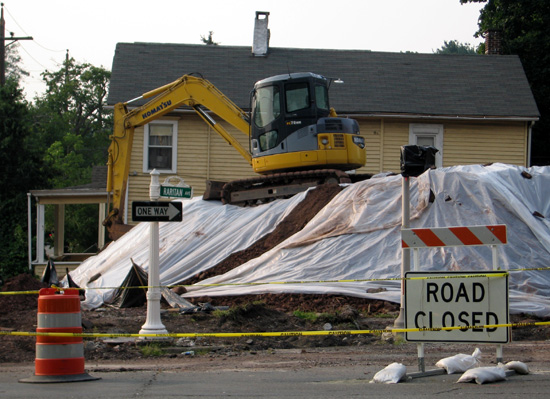
Construction equipment rests high in the air atop materials it has scooped out at the future site of the Centennial Park. Because this was a former limo lot, the soils had to be studied in advance of the July digging in case serious pollutants might be found that could deter construction. They weren’t.
Photo: Arnold Clayton Henderson 7/11/2006

Centennial Park Construction

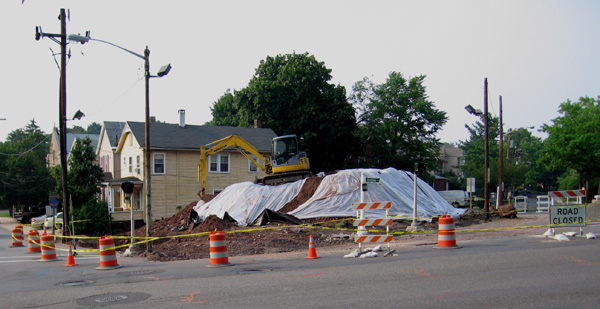
Construction began in July 2006 for Centennial Park in the triangular lot formed by the intersection of River Road, Raritan Avenue, and Lincoln Avenue. This will be primarily a ‘visual’ park for most people, the first thing drivers entering Highland Park will see as they cross the bridge over the Raritan River.
Photo: Arnold Clayton Henderson 7/11/2006

Search HPEC Website

News from HPEC

  • HP Leaf Blower Taskforce Report
  • Guided Tour along The Meadows Trail to Celebrate Earth Day
  • Spring Has Arrived. Birds Have Migrated From The South.
  • Does Highland Park Recycle – YES!
  • Winter Ducks Return
This website is devoted to informing the public about nature, open space and the environment in and around Highland Park, New Jersey. Content is provided by members of the Environmental Commission of the Borough of Highland Park, New Jersey. The Raritan River plays a key role in the Highland Park environment.
Theme by Colorlib Powered by WordPress